Monthly Market Commentary – April 2026
(As of 04/30/2026)
Monthly Strategy Commentary
By Kensington Asset Management Team
Stock Market
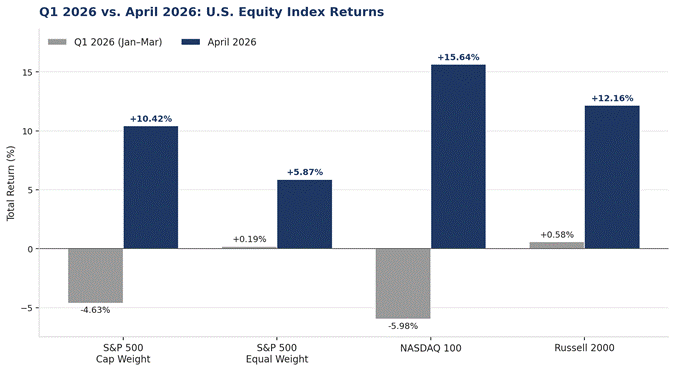
April delivered one of the strongest monthly performances for US equities relative to recent periods, driven by a combination of corporate earnings trends and a re-acceleration of the AI investment theme. The S&P 500 gained 10.42%, the Russell 2000 appreciated 12.16%, and the Nasdaq 100 advanced 15.64%. International markets participated as well, with the MSCI EAFE Index up 5.08% and the MSCI Emerging Markets Index higher by 13.26%, helped in part by a weaker US dollar.
Beyond the headline index returns, the semiconductor complex showed a notable area of performance during the period. The iShares Semiconductor ETF (SOXX) returned 40.4% in April, the largest monthly return in the fund’s 25-year history. The VanEck Semiconductor ETF (SMH) was up 32.2%, also a record monthly move. The eight-percentage-point gap between the two reflects the unusual character of this rally, with breadth across the chip universe rather than concentration in the few names that drove prior phases of the AI trade. Advanced Micro Devices gained 74.3% during the month according to S&P Global Market Intelligence, while Nvidia, the dominant performer of 2024 and 2025, rose a comparatively modest 21.9%. Marvell Technology gained more than 60%. The magnitude and breadth of the move within the sector is the kind of dispersion that may be relevant for investors to consider when evaluating portfolio exposures.
From a systematic standpoint, a notable development was the speed and breadth of the risk-on signal reset. Equity trend indicators flipped to a synchronized positive reading across the S&P 500, Nasdaq 100, and Russell 2000 during the week of April 20, the first such reading since the March drawdown. Equity volatility moved alongside it, with the VIX falling from above 19 in early April to under 19 by month-end. Rate volatility told a similar story, as the MOVE Index dropped from above 72 to the mid-60s. High yield spreads tightened more than 25 basis points from their early-April peak, ending the month near 286 basis points, while investment grade spreads remained in the low 80s.
Market Concentration and Breadth
The strength of the rally raises the perennial question of how much of the index move is broad-based versus concentrated in a narrow set of leaders. The April data provides context on this point. The S&P 500 returned 10.42% on a cap-weighted basis, but only 5.87% on an equal-weighted basis, a 455 basis point gap in a single month. According to Nomura research, in the 28-session rally from late March through early May, just ten stocks accounted for roughly 69% of the index’s gains, with Alphabet, Nvidia, Amazon, Broadcom, and Microsoft leading the contribution.
The chart below shows how this dynamic shifted during April. Through the first quarter of 2026, the cap-weighted S&P 500 and the Nasdaq 100 were both negative, while the Equal Weight and Russell 2000 held in slightly positive territory. April reversed that pattern entirely. The mega-cap-led indices surged while the broader measures lagged.
Source: Bloomberg, S&P Dow Jones Indices, MSCI. Q1 returns calculated from year-to-date and April data.
Concentration at the top of the index has continued to build. The ten largest stocks in the S&P 500 represented roughly 40% of total index weight at the end of April, compared to a 30-year average of approximately 25%. Those ten companies are also estimated to generate roughly 32% of total index earnings, leaving a meaningful gap between market value concentration and underlying earnings contribution. Periods of elevated concentration in market history have resolved in different ways and over different time frames, so the data is descriptive rather than predictive. The data suggests that index-level returns have become increasingly sensitive to a narrow group of names, which is a factor worth understanding when evaluating portfolio exposures.
Fixed Income
Fixed income markets diverged sharply from equities in April. Longer-dated Treasuries declined, with the 10-Year and 30-Year off 0.22% and 0.89% respectively. Bloomberg US Mortgage-backed securities Index was essentially flat while Investment Grade Corporates Index managed a 0.45% gain. The equity-sensitive US corporate high yield index was the bright spot, up 1.69% as spreads tightened materially through the month.
In our assessment, several factors appear to have contributed to Treasury performance. The lingering effects of the March energy shock continued to show up in prices at both the producer and consumer level. The price gauge in the ISM Manufacturing PMI surged to 84.6 in April from 78.3 in the prior month, marking the highest reading since April 2022. Headline CPI rose 0.6% month-over-month, following a 0.9% jump in March, lifting the annual rate to 3.8%, the highest since May 2023. Core CPI rose 0.4% month-over-month and 2.8% year-over-year. While fuel and energy prices had an outsized impact, the broadening into core categories suggests inflationary pressure is leaking into the wider economy.
Consumer inflation expectations have been more stable. Both the New York Federal Reserve and University of Michigan surveys showed little change in headline expectations through most of the period. However, the NY Fed survey noted a sharp increase in disagreement, measured as the gap between the 25th and 75th percentiles of respondents. The average consumer is not yet worried about inflation, but the number expecting very high inflation has grown. Historically, this kind of widening distribution has sometimes preceded broader shifts in inflation expectations, though it is not necessarily predictive of future outcomes. If the outliers gradually become the majority view, median expectations will follow.
Another factor worth noting is the consumer’s broader outlook. Even with equity markets reaching new highs, the University of Michigan Consumer Sentiment Index registered a final April reading of 49.8, the lowest in the survey’s history dating back to 1978. The index now sits below where it stood at the start of every prior recession since the survey began. What may make this episode different is the unemployment backdrop. In prior cycles, sentiment only dropped this low when joblessness was rising sharply. If employment conditions remain stable, consumer spending may continue to show resilience.
Federal Reserve and Monetary Policy
The Powell era at the Federal Reserve has formally come to a close, and a new chapter under Chairman Kevin Warsh is now underway. Warsh is widely expected to lead with a different policy approach, including a preference for a smaller balance sheet and less scripted communication than markets have grown accustomed to. It remains to be seen how comfortable investors will be with that shift, and the recent rise in long-end yields may partly reflect a higher risk premium being demanded during the transition.
Warsh assumes the role at a tenuous moment, with prices firming across portions of the economy and questions still circulating about his inflation-fighting credentials. New Fed Chairs have frequently been tested early in their tenures. Paul Volcker was confronted almost immediately in 1979 by a collapsing dollar and surging gold prices, ultimately overhauling the Fed’s operating framework to target the money supply and demonstrating a willingness to accept recession to defeat inflation. Ben Bernanke faced a different kind of test in 2006 when off-the-cuff remarks at the White House Correspondents’ Dinner, later reported by CNBC, were interpreted by markets as a dovish signal, prompting a sharp sell-off and effectively forcing additional tightening to reestablish credibility.
Warsh may be tested as well, both on his independence from the White House and on the degree to which he holds firm to the view that artificial intelligence will deliver a significant productivity boost. That view, if held strongly, could contribute to a less restrictive policy stance than current inflation data might otherwise suggest, which is a source of ongoing debate among market participants.
Market expectations for rate cuts have shifted meaningfully. According to the CME FedWatch Tool, market-implied probabilities now overwhelmingly point to the Fed holding the current 3.50% to 3.75% range, with a notable increase in the likelihood of a rate hike by December. Markets are currently pricing roughly one-in-three odds of a hike, up from less than 1% just a month ago.
Disclaimers:
Investing involves risk, including possible loss of principal. Past performance does not guarantee future results. No strategy, including diversification, ensures a profit or prevents loss.
This is for informational purposes only and is not a recommendation nor solicitation to buy, sell or invest in any investment product or strategy. ETFs shown for illustrative purposes only; not an investment recommendation. Our materials may contain information deemed to be correct and appropriate at a given time but may not reflect our current views or opinions due to changing market conditions. No information provided should be viewed as or used as a substitute for individualized investment advice. An investor should consider the investment objectives, risks, charges, and expenses of the investment and the strategy carefully before investing.
Kensington Asset Management, LLC (“KAM”) relies on third party sources for some of its information that we believe is reliable. However, we make no representation, warranty, endorse or affirm as to its accuracy or completeness. The information provided is current as of the date of publication and may be subject to change. We are not responsible for updating this information to reflect any subsequent developments or events.
Certain information contained herein constitutes “forward-looking statements,” which can be identified using forward-looking terminology such as “may,” “will,” “should,” “expect,” “anticipate,” “project,” “estimate,” “intend,” “continue,” or “believe,” or the negatives thereof or other variations thereon or comparable terminology. Due to various risks and uncertainties, actual events, results, or actual performance may differ materially from those reflected or contemplated in such forward-looking statements. Nothing contained herein may be relied upon as a guarantee, promise, assurance, or a representation as to the future.
Advisory services offered through Kensington Asset Management, LLC, Barton Oaks Plaza, Bldg II, 901 S Mopac Expy – Ste 225, Austin, TX 78746. Xtollo Investment Partners, LLC (“XIP”) promotes KAM strategies and funds and receives compensation for these activities, which creates a conflict of interest. XIP is not a registered investment adviser or broker-dealer.
Please refer to Important Disclosures | Glossary
KAM20260518
Related Perspectives
View All-
Monthly Market Commentary – July 2026
June’s central tension was that positive US economic data coincided with weakness in certain large-cap equities.
-
Monthly Market Commentary – June 2026
June’s central tension was that positive US economic data coincided with weakness in certain large-cap equities.
